Musical notation defines two different parameters – pitch and rhythym, ie. which note to play and when. This section deals with just the rhythmic aspects of notation, which includes rests. (It is equally important to know when not to play as when to play).
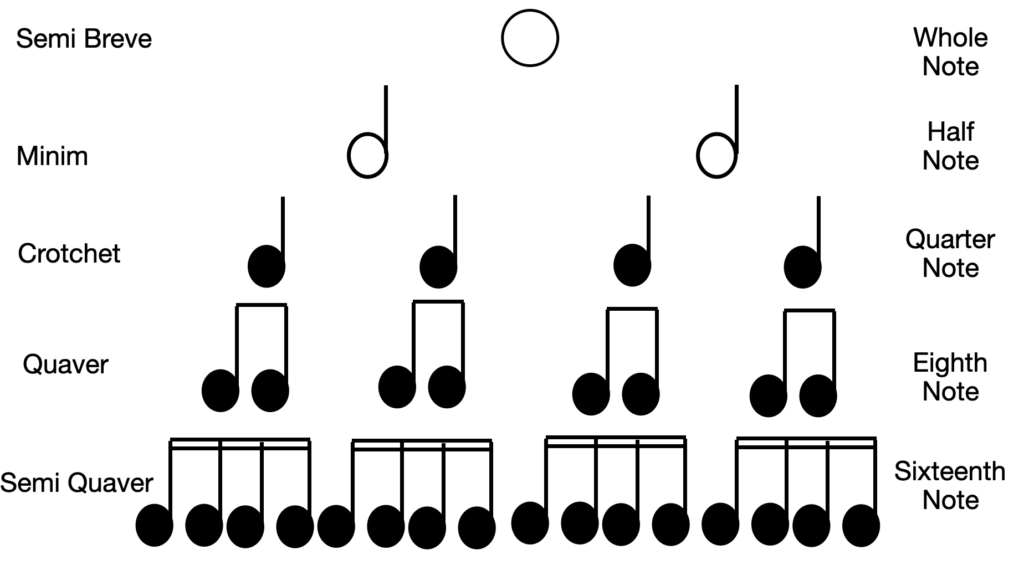
Notes and rests vary depending on the length of note that is required. Although initially confusing, there is a pattern to the way that the different notes indicate their length. The most common note lengths that we will use are shown below. For each one there is the traditional name, and also the American name (which some people find to be more easily understood).
Semi Breve, or Whole Note
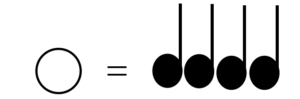
A semi breve, or Whole Note, is the same length as four crotchets. It represents a whole bar in 4/4 time.
Minim or Half Note
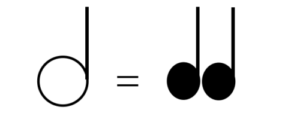
A minim, or Half Note, is the same length as two crotchets. There are two minims in a bar in 4/4/ time.
Crotchet, or Quarter Note
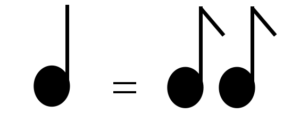
Crotchet, or Quarter Note is the same length as two Quavers. There are four crotchets in a bar of 4/4 time, and it is often regarded as the base unit in regular notation.
Quaver, or Eighth Note
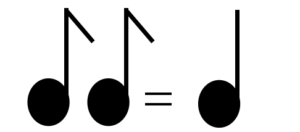
A quaver, or Eighth Note, is half the length of a crotchet. There are eight quavers in a bar of 4/4 time.
Semi Quaver, or Sixteenth Note
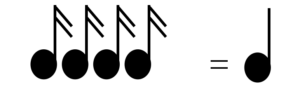
A semi-quaver, or Sixteenth note, is half the length of a quaver, and a quarter of the length of a crotchet. There are sixteen semi-quavers in a bar of 4/4 time.
Summary
Time Signatures
A time signature tells us how many beats there are in a bar, and of what value. It is written as one number above another, which looks a bit like a fraction, as shown below. The top value indicates the number of beats in the bar, and the bottom value indicates the type of beat.
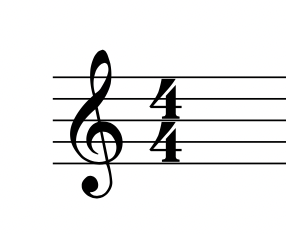
The example above indicates that there four beats to the bar, and that each bar is worth a crotchet. This is what has led to the American terminology, where crotchets are known as ‘quarter’ notes, as it looks like a 4/4 fraction (e.g. 4 quarters). Unfortunately, if you are not using the American terminology, then you simply have to learn what they mean. The following table shows the different type of beat values
- 2 = Minim
- 4 = Crotchet
- 8 = Quaver
- 16 = Semiquaver
The 4/4 time signature does not mean that the bar can only contain crotchets or eigtth notes, but that the total note value must add up to a total of four crotchets. For example a bar could contain a minim, a crotchet and two quavers because :
- A minim equals 2 crotchets
- A quaver equals half a crotchet
- Minim + Crotchet + Quaver + Quaver = 2 Crotchets + 1 Crotchet + 1/2 Crotchet + 1/2 Crotchet = 4 Crotchets
Examples
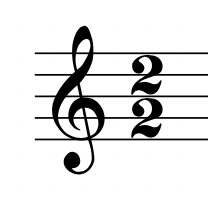
A ‘2‘ indicates that the beat is minims – therefor there are two minims in a bar. This means that each bar can also contain four crotchets, eight quavers, etc, or a combination of the these.
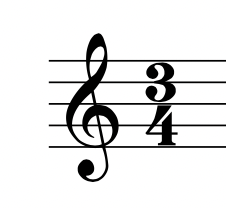
A ‘4‘ indicates that the beat is crotchets – therefor there are three crotchets in a bar. This means that each bar can also contain a minim and a crotchet, three crotchets, six quavers, etc, or a combination of the these.
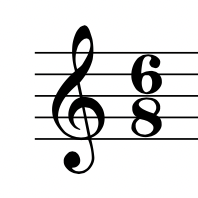
An ‘8‘ indicates that the beat is quavers – therefor there are six quavers in a bar. This means that each bar can also contain up to three crotchets, six quavers, etc, or a combination of the these.
Note – you may realise that both 3/4 and 6/8 can contain up to 6 quavers in value, but they are not the same – 6/8 is an example of compound time – see separate section later.
Dotted Notes
A dot after a note increases its length by half again. A dotted crotchet is therefore worth the equivilent of three quavers. this is because a crotchet on its own is worth two quavers, so the dot make it hald as long again. Half of 2 is 1, so a dotted crotchet is worth 3 quavers (2 + 1).
Look at the first bar of music below.
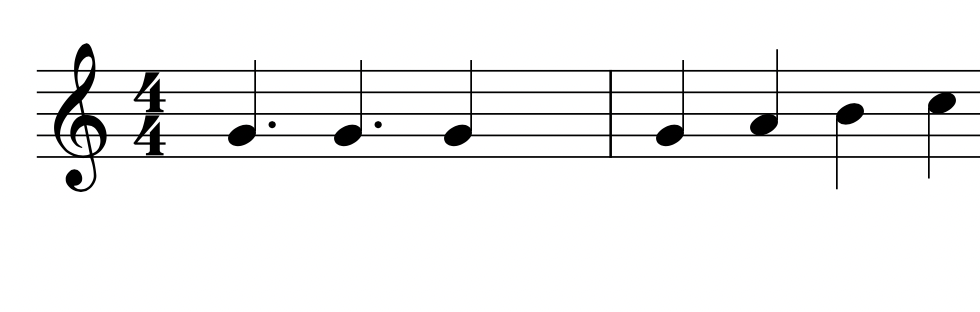
The first thing to note is that the time signature is 4/4 – this means that the values in each bar must add up to four crotchets. There are 3 crotchets in the first bar, which looks incomplete at first sight, but closer inspection shows that there is a dot after the first two notes. This means that they last half as long again, which makes them equal to a crotchet and a half, or three quavers. If we think in quaver values, there should be a total of eight quavers in each bar, and the three notes have the values of 3, 3 and 3 respectively. this means that the total note length ion the bar is 8 quavers, which equals 4 crotchets, which equals the time signature.
1.5 crotchets + 1.5 crotchets + 1 crotchet = 8 crotchets
or
3 quavers + 3 quavers + 2 quavers = 8 quavers.
Double Dotted Notes
In the same way that a dot after a note extends its value by half, a second dot means that it is extended by half of that half (i.e. a quarter). This can seem confusing, but if we think of a crotchet and its quaver and semi quaver equivalents;
- 1 crotchet = 2 quavers = 4 semiquavers
- A dotted crotchet = 1.5 crotchets = 3 quavers = 6 semiquavers
- A double dotted crotchet = 1.75 crotchets = 3.5 quavers = 7 semiquavers
To break down that double dotted example;
- The crotchet indicates that we start with the equivalent of 2 quavers
- The first dot indicates that we extend it by half of what we already have, which is another quaver, so we now have a total of 3 quavers, or 6 semiquavers
- The second dot indicates that we extend it again, by half of what we just extended it by! We have already extended it by a quaver, so therefore we extend it by another half of a quaver, i.e. a semiquaver, which gives 7 semiquavers.
The following shows an example of this
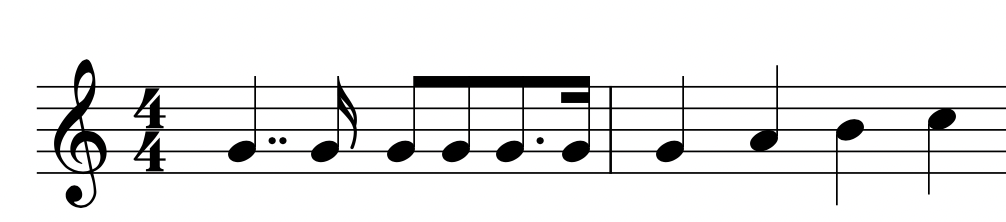
Working through this bar we have;
- A double dotted crotchet (which equals 7 semi quavers)
- Another semi quaver. By this point we have a total of 8 semiquavers, which equals 2 crotchets so we are half way through the bar.
- 2 quavers follow, which equals 1 crotchet, so we are now 3/4 of the way through the bar (total of 3 crotchets).
- The final 2 notes are a dotted quaver followed by a semi quaver. This is equal to 3 semiquavers plus another semiquaver, which equals 2 quaver or a crotchet. Combined with the 3 crotchets prio to this, we now have a total of 4 cortchets which completes our bar.
Simple and Compound Time
Music is more than just maths. Up to now we have just been adding up note values to make up our bar lengths, but we should also think about the pulse of the beat of the music. 4/4 time indicates that there are 4 beats in the bar, and this is the most common form of music, especially in bluegrass.Even when there are more than 4 notes in a bar, we can feel the pulse as 4 distinct beats, and this is often why songs are counted in with “1, 2, 3, 4“.
Simple Time
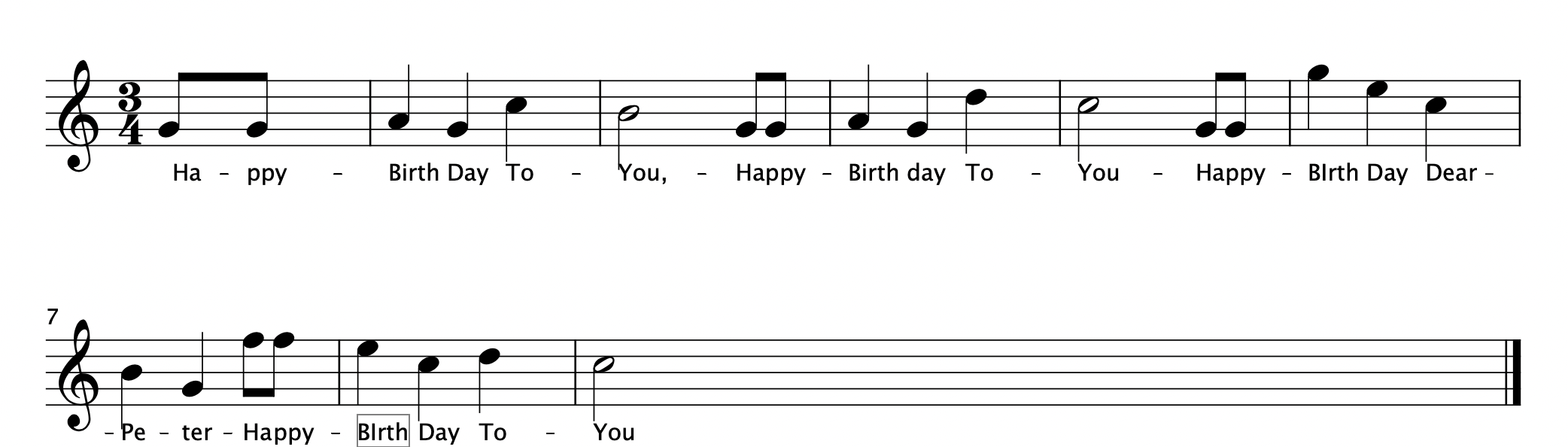
In Simple Time, each beat can be sub divided into 2 or 4 beats. Think about ‘Happy Birthday’. This is in 3/4 time, and there is a very strong feeling of three beats as we sing the melody (see letters marked in bold). If a time signature starts with 2, 3 or 4, then it is almost certainly Simple Time.
“Happy BirthDay To You, Happy BirthDay To You, Happy BirthDay ,Dear Peter, Happy BirthDay To You.”
When we notate Happy Birthday, it looks like this. We can see that in most of the melody there are single crotchet beats, and when there are quavers, there are very clearly 2 to each beat.
Compound Time
In Compound Time, each beat is divided into 3. The most obvious example Compound Time is a piece in 6/8, where there are two beats of 3 quaver each. Think of the tune ‘Nelly The Elephant’;
Nelly the Elephant packed her trunk, and ran away to the circus.
There is a very obvious emphasis on the strong beats (Nelly, Elephant, etc) and we can also feel a “1 – 2 – 3” beat underneath. Although there are six quavers i the bar, in the same way as Happy Birthday, the feel is completely different – 1 2 3 4 5 6, rather than 1 2 3.
When we look at the tune, we can clearly see that it is grouped in beats of 3 quavers, and the first of each group is where the emphasis, or beat is. In the second bar, where we see crotchet followed by quaver, it is still clearly a total of three quavers for each beat.

Other examples of Compound time are 9/8, 12/8, etc. If the number of notes is divisible by 3, then it is probably Compound Time.
There are some good explanations of Simple and Compound time on You Tube – for example at https://www.youtube.com/watch?v=hvkr3H2D08g
Rests
Each type of note has a corresponding rest, which indicates that there should be silence for that note length. The following diagram shows the different types of note, and the equivalent rest
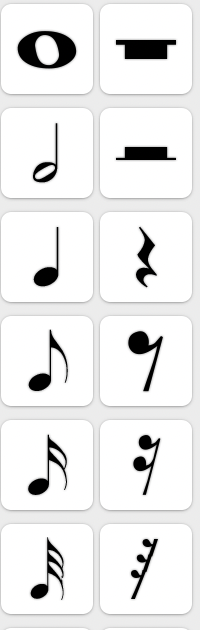
There are a few things to take note of here. The semibreve and minim rest are very similar, a block either above or below the line. A good way of remembering the differnce is that the minim is not as strong as a semibreve (because it is only half the size) soi its rest block has to sit on the line, where as the stronger semibreve can sit underneath it.
The crotchet rest is a sort of squiggle, and the the quaver and its subdivision are like a ‘seven’ with the number of horizontal bars matching the number of bars on the related note – one for a quaver, two for a semi quaver, and so on. Notice that there is a note type that we have not mentioned yet – three horizontal bars which means that it is half the length of a semiquaver, and known as a demi-semi quaver. There is also a four bar note which is a hemi-demi-semi quaver!
Once we have learnt which rest is used for diffent types of notes, the method of using them in a bar is just the same as with note, and the number of elements count up until the bar is filled, be they crotchets, quavers, semiquavers, etc.
Example of Rests
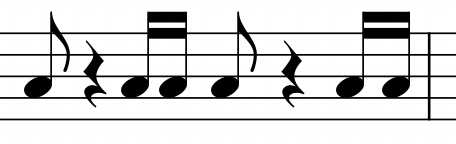
The following example is a section of percussion music, where the drum rhythm is notated on a single line, so ignore the pitch. The use of notes and rests to determine the rhythm is identical to pitched instruments. The example is in 4/4 time.

Look at the first bar above. The first note is a quaver, followed by a single quaver rest. This adds up to a crotchet – i.e. a single beat in 4/4 time. This is followed by two crotchet rests, which are betas 2 and 3, and finally 4 semiquavers, which make up the 4th and final beat of the bar.
It is worth noting that the second and third beats of the bar are two crotchets which are the same as a minim. Therefore this bar could be notated with a minim rest, but this would be incorrect – the same as spelling a word incorrectly. There are four beats in the bar, and therefore each beat must be separate – hence the use of two rests instead of one minim crotchet.
The second bar is the same as the first, and then in the final bar we have a quaver followed by two quaver rests. Similarly to the first bar, these rests are separate quavers rather than a single crotchet, because each beat has to be separated. Using a crotchet rest instead of two quavers would cross and therefore obscure the beat.
The following shows the third bar above notated incorrectly. Note that it is suddenly harder to see where the four individual beats are on the bar as they are obscured by the incorrect use of a crotchet rest instead of two separate quaver rests.